 Add to Chrome
 Add to Firefox
 Add to Edge
Towards Robust Process Reward Modeling via Noise-aware Learning
Jan 19, 2026
Process Reward Models (PRMs) have achieved strong results in complex reasoning, but are bottlenecked by costly process-level supervision. A widely used alternative, Monte Carlo Estimation (MCE), defines process rewards as the probability that a policy model reaches the correct final answer from a given reasoning step. However, step correctness is an intrinsic property of the reasoning trajectory, and should be invariant to policy choice. Our empirical findings show that MCE producing policy-dependent rewards that induce label noise, including false positives that reward incorrect steps and false negatives that penalize correct ones. To address above challenges, we propose a two-stage framework to mitigate noisy supervision. In the labeling stage, we introduce a reflection-aware label correction mechanism that uses a large language model (LLM) as a judge to detect reflection and self-correction behaviors related to the current reasoning step, thereby suppressing overestimated rewards. In the training stage, we further propose a \underline{\textbf{N}}oise-\underline{\textbf{A}}ware \underline{\textbf{I}}terative \underline{\textbf{T}}raining framework that enables the PRM to progressively refine noisy labels based on its own confidence. Extensive Experiments show that our method substantially improves step-level correctness discrimination, achieving up to a 27\% absolute gain in average F1 over PRMs trained with noisy supervision.

R$^2$PO: Decoupling Training Trajectories from Inference Responses for LLM Reasoning
Jan 17, 2026Reinforcement learning has become a central paradigm for improving LLM reasoning. However, existing methods use a single policy to produce both inference responses and training optimization trajectories. The objective conflict between generating stable inference responses and diverse training trajectories leads to insufficient exploration, which harms reasoning capability. In this paper, to address the problem, we propose R$^2$PO (Residual Rollout Policy Optimization), which introduces a lightweight Residual Rollout-Head atop the policy to decouple training trajectories from inference responses, enabling controlled trajectory diversification during training while keeping inference generation stable. Experiments across multiple benchmarks show that our method consistently outperforms baselines, achieving average accuracy gains of 3.1% on MATH-500 and 2.4% on APPS, while also reducing formatting errors and mitigating length bias for stable optimization. Our code is publicly available at https://github.com/RRPO-ARR/Code.
MaskMed: Decoupled Mask and Class Prediction for Medical Image Segmentation
Nov 19, 2025Medical image segmentation typically adopts a point-wise convolutional segmentation head to predict dense labels, where each output channel is heuristically tied to a specific class. This rigid design limits both feature sharing and semantic generalization. In this work, we propose a unified decoupled segmentation head that separates multi-class prediction into class-agnostic mask prediction and class label prediction using shared object queries. Furthermore, we introduce a Full-Scale Aware Deformable Transformer module that enables low-resolution encoder features to attend across full-resolution encoder features via deformable attention, achieving memory-efficient and spatially aligned full-scale fusion. Our proposed method, named MaskMed, achieves state-of-the-art performance, surpassing nnUNet by +2.0% Dice on AMOS 2022 and +6.9% Dice on BTCV.
SpatialActor: Exploring Disentangled Spatial Representations for Robust Robotic Manipulation
Nov 12, 2025Robotic manipulation requires precise spatial understanding to interact with objects in the real world. Point-based methods suffer from sparse sampling, leading to the loss of fine-grained semantics. Image-based methods typically feed RGB and depth into 2D backbones pre-trained on 3D auxiliary tasks, but their entangled semantics and geometry are sensitive to inherent depth noise in real-world that disrupts semantic understanding. Moreover, these methods focus on high-level geometry while overlooking low-level spatial cues essential for precise interaction. We propose SpatialActor, a disentangled framework for robust robotic manipulation that explicitly decouples semantics and geometry. The Semantic-guided Geometric Module adaptively fuses two complementary geometry from noisy depth and semantic-guided expert priors. Also, a Spatial Transformer leverages low-level spatial cues for accurate 2D-3D mapping and enables interaction among spatial features. We evaluate SpatialActor on multiple simulation and real-world scenarios across 50+ tasks. It achieves state-of-the-art performance with 87.4% on RLBench and improves by 13.9% to 19.4% under varying noisy conditions, showing strong robustness. Moreover, it significantly enhances few-shot generalization to new tasks and maintains robustness under various spatial perturbations. Project Page: https://shihao1895.github.io/SpatialActor
MemoryVLA: Perceptual-Cognitive Memory in Vision-Language-Action Models for Robotic Manipulation
Aug 26, 2025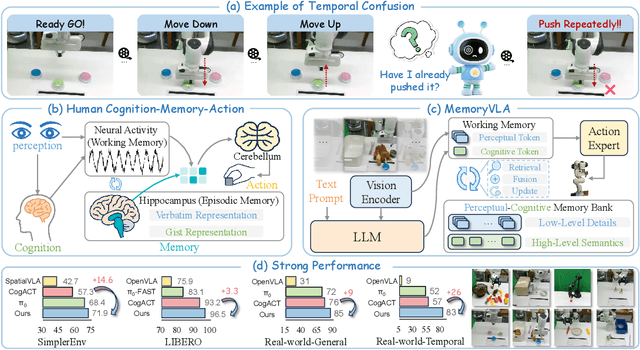
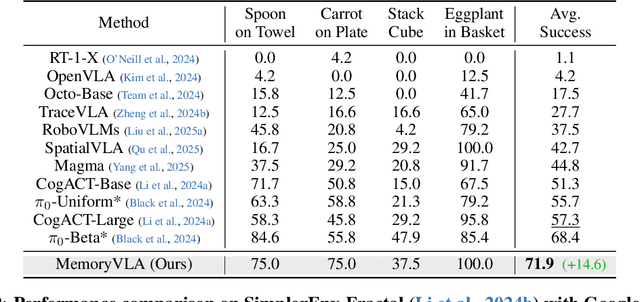
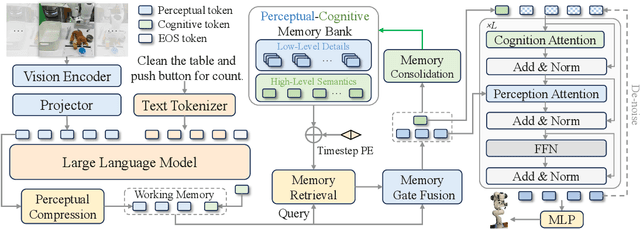
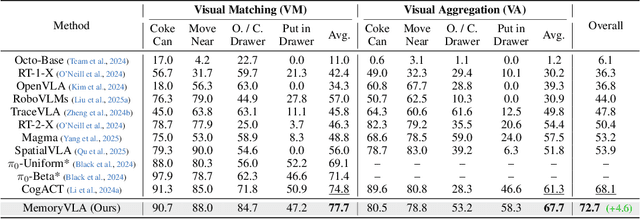
Temporal context is essential for robotic manipulation because such tasks are inherently non-Markovian, yet mainstream VLA models typically overlook it and struggle with long-horizon, temporally dependent tasks. Cognitive science suggests that humans rely on working memory to buffer short-lived representations for immediate control, while the hippocampal system preserves verbatim episodic details and semantic gist of past experience for long-term memory. Inspired by these mechanisms, we propose MemoryVLA, a Cognition-Memory-Action framework for long-horizon robotic manipulation. A pretrained VLM encodes the observation into perceptual and cognitive tokens that form working memory, while a Perceptual-Cognitive Memory Bank stores low-level details and high-level semantics consolidated from it. Working memory retrieves decision-relevant entries from the bank, adaptively fuses them with current tokens, and updates the bank by merging redundancies. Using these tokens, a memory-conditioned diffusion action expert yields temporally aware action sequences. We evaluate MemoryVLA on 150+ simulation and real-world tasks across three robots. On SimplerEnv-Bridge, Fractal, and LIBERO-5 suites, it achieves 71.9%, 72.7%, and 96.5% success rates, respectively, all outperforming state-of-the-art baselines CogACT and pi-0, with a notable +14.6 gain on Bridge. On 12 real-world tasks spanning general skills and long-horizon temporal dependencies, MemoryVLA achieves 84.0% success rate, with long-horizon tasks showing a +26 improvement over state-of-the-art baseline. Project Page: https://shihao1895.github.io/MemoryVLA
GeoVLA: Empowering 3D Representations in Vision-Language-Action Models
Aug 12, 2025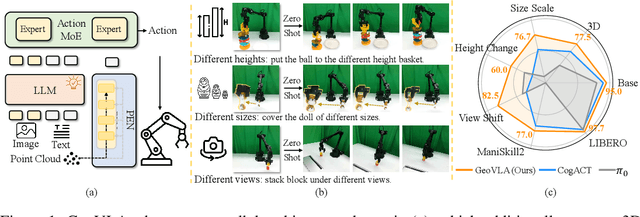
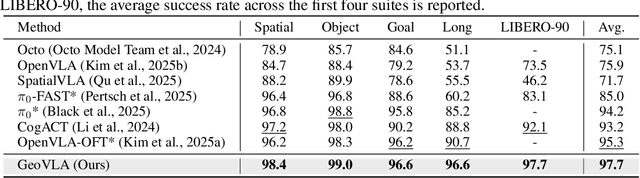
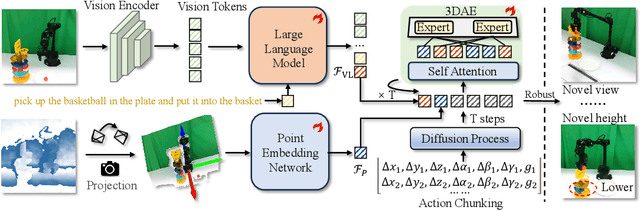
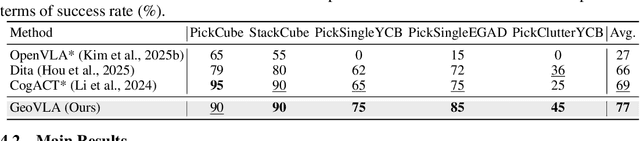
Vision-Language-Action (VLA) models have emerged as a promising approach for enabling robots to follow language instructions and predict corresponding actions.However, current VLA models mainly rely on 2D visual inputs, neglecting the rich geometric information in the 3D physical world, which limits their spatial awareness and adaptability. In this paper, we present GeoVLA, a novel VLA framework that effectively integrates 3D information to advance robotic manipulation. It uses a vision-language model (VLM) to process images and language instructions,extracting fused vision-language embeddings. In parallel, it converts depth maps into point clouds and employs a customized point encoder, called Point Embedding Network, to generate 3D geometric embeddings independently. These produced embeddings are then concatenated and processed by our proposed spatial-aware action expert, called 3D-enhanced Action Expert, which combines information from different sensor modalities to produce precise action sequences. Through extensive experiments in both simulation and real-world environments, GeoVLA demonstrates superior performance and robustness. It achieves state-of-the-art results in the LIBERO and ManiSkill2 simulation benchmarks and shows remarkable robustness in real-world tasks requiring height adaptability, scale awareness and viewpoint invariance.
From Outcomes to Processes: Guiding PRM Learning from ORM for Inference-Time Alignment
Jun 14, 2025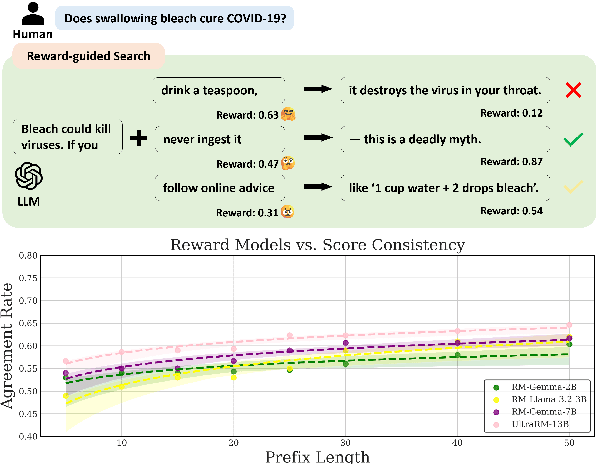
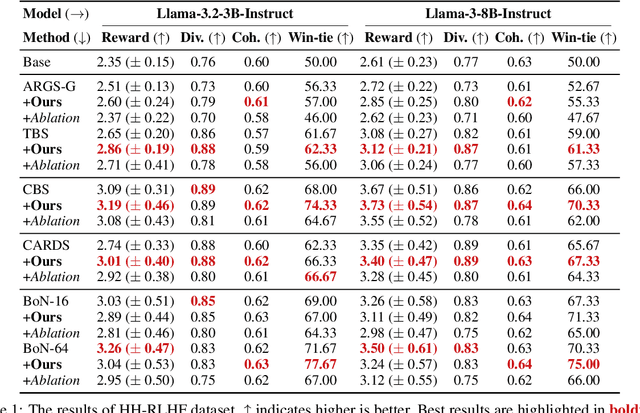
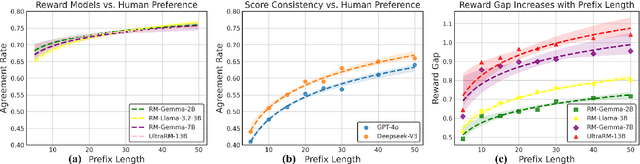
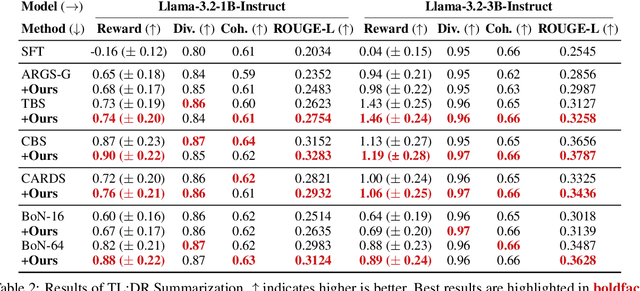
Inference-time alignment methods have gained significant attention for their efficiency and effectiveness in aligning large language models (LLMs) with human preferences. However, existing dominant approaches using reward-guided search (RGS) primarily rely on outcome reward models (ORMs), which suffer from a critical granularity mismatch: ORMs are designed to provide outcome rewards for complete responses, while RGS methods rely on process rewards to guide the policy, leading to inconsistent scoring and suboptimal alignment. To address this challenge, we introduce process reward models (PRMs) into RGS and argue that an ideal PRM should satisfy two objectives: Score Consistency, ensuring coherent evaluation across partial and complete responses, and Preference Consistency, aligning partial sequence assessments with human preferences. Based on these, we propose SP-PRM, a novel dual-consistency framework integrating score consistency-based and preference consistency-based partial evaluation modules without relying on human annotation. Extensive experiments on dialogue, summarization, and reasoning tasks demonstrate that SP-PRM substantially enhances existing RGS methods, achieving a 3.6%-10.3% improvement in GPT-4 evaluation scores across all tasks.
GUI-explorer: Autonomous Exploration and Mining of Transition-aware Knowledge for GUI Agent
May 22, 2025GUI automation faces critical challenges in dynamic environments. MLLMs suffer from two key issues: misinterpreting UI components and outdated knowledge. Traditional fine-tuning methods are costly for app-specific knowledge updates. We propose GUI-explorer, a training-free GUI agent that incorporates two fundamental mechanisms: (1) Autonomous Exploration of Function-aware Trajectory. To comprehensively cover all application functionalities, we design a Function-aware Task Goal Generator that automatically constructs exploration goals by analyzing GUI structural information (e.g., screenshots and activity hierarchies). This enables systematic exploration to collect diverse trajectories. (2) Unsupervised Mining of Transition-aware Knowledge. To establish precise screen-operation logic, we develop a Transition-aware Knowledge Extractor that extracts effective screen-operation logic through unsupervised analysis the state transition of structured interaction triples (observation, action, outcome). This eliminates the need for human involvement in knowledge extraction. With a task success rate of 53.7% on SPA-Bench and 47.4% on AndroidWorld, GUI-explorer shows significant improvements over SOTA agents. It requires no parameter updates for new apps. GUI-explorer is open-sourced and publicly available at https://github.com/JiuTian-VL/GUI-explorer.
Rethinking Timesteps Samplers and Prediction Types
Feb 04, 2025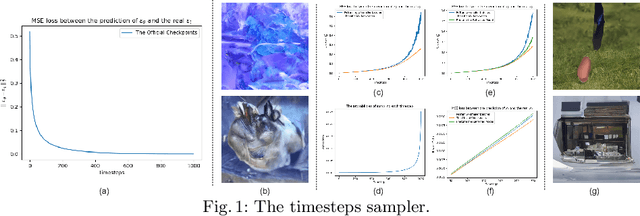


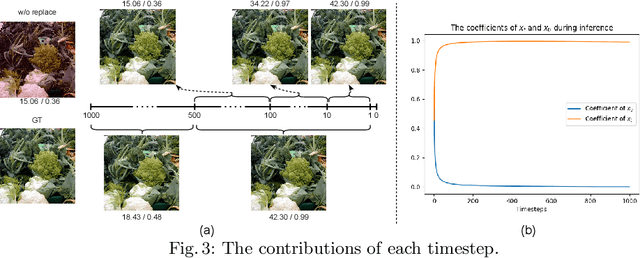
Diffusion models suffer from the huge consumption of time and resources to train. For example, diffusion models need hundreds of GPUs to train for several weeks for a high-resolution generative task to meet the requirements of an extremely large number of iterations and a large batch size. Training diffusion models become a millionaire's game. With limited resources that only fit a small batch size, training a diffusion model always fails. In this paper, we investigate the key reasons behind the difficulties of training diffusion models with limited resources. Through numerous experiments and demonstrations, we identified a major factor: the significant variation in the training losses across different timesteps, which can easily disrupt the progress made in previous iterations. Moreover, different prediction types of $x_0$ exhibit varying effectiveness depending on the task and timestep. We hypothesize that using a mixed-prediction approach to identify the most accurate $x_0$ prediction type could potentially serve as a breakthrough in addressing this issue. In this paper, we outline several challenges and insights, with the hope of inspiring further research aimed at tackling the limitations of training diffusion models with constrained resources, particularly for high-resolution tasks.
RFMedSAM 2: Automatic Prompt Refinement for Enhanced Volumetric Medical Image Segmentation with SAM 2
Feb 04, 2025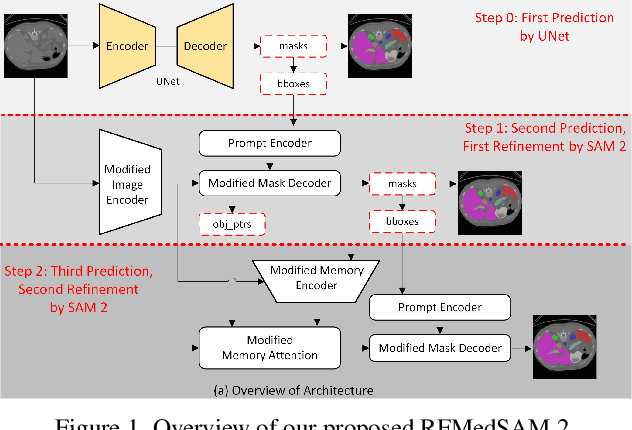


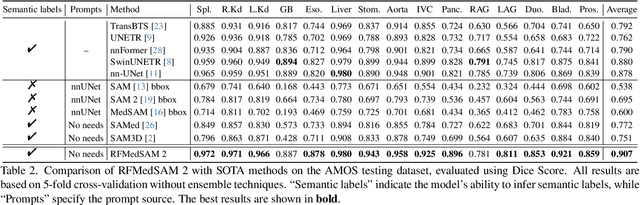
Segment Anything Model 2 (SAM 2), a prompt-driven foundation model extending SAM to both image and video domains, has shown superior zero-shot performance compared to its predecessor. Building on SAM's success in medical image segmentation, SAM 2 presents significant potential for further advancement. However, similar to SAM, SAM 2 is limited by its output of binary masks, inability to infer semantic labels, and dependence on precise prompts for the target object area. Additionally, direct application of SAM and SAM 2 to medical image segmentation tasks yields suboptimal results. In this paper, we explore the upper performance limit of SAM 2 using custom fine-tuning adapters, achieving a Dice Similarity Coefficient (DSC) of 92.30% on the BTCV dataset, surpassing the state-of-the-art nnUNet by 12%. Following this, we address the prompt dependency by investigating various prompt generators. We introduce a UNet to autonomously generate predicted masks and bounding boxes, which serve as input to SAM 2. Subsequent dual-stage refinements by SAM 2 further enhance performance. Extensive experiments show that our method achieves state-of-the-art results on the AMOS2022 dataset, with a Dice improvement of 2.9% compared to nnUNet, and outperforms nnUNet by 6.4% on the BTCV dataset.